Welcome to Jens' page on
Numerical Magnetohydrodynamics
in the Solar System
|
|
|
The field of hydrodynamics (HD for short) seeks to describe a liquid's
motion in a
given environment, as it results from the forces which act upon the fluid.
It has been generalized to apply to compressible media (gases), and nowadays
has a
vast range of application in science and technology, comprising, among other
things, oceanography, weather and climate studies, aeronautical engineering,
flow studies related to vehicle design, and the like.
In many astrophysical settings (like the Sun's interior, as well as the
interplanetary and interstellar medium), the gas is ionized, such that its
motion is subject not only to gas pressure and gravity, but also to
electromagnetic forces. Their incorporation into the fluid picture of HD
results in a set of similar (but somewhat more complicated) equations, which
then constitute the extension of
HD to magnetohydrodynamics (MHD for short).
The (M)HD approach of treating an assembly of (many) atoms and molecules as a
continuous medium
critically relies on the assumption that the length and time scales on which
any two particles interact (e.g. via collisions) is negligible against the
macroscopic scales which are to be considered. But while this is usually
well satisfied for air or water, magnetized gases (especially those usually
considered in astrophysics) present a more complex issue, and can often
exhibit collective behavior of particle ensembles resulting in
macroscopic effects of the gas/fluid as a whole. Therefore, the validity of
the MHD picture for a given astrophysical setting has to be assessed carefully
before it is applied.
As with many objects of scientific study, the theoretical investigation
of magnetized fluids relies
upon models to study their characteristic properties. The delicate task
is to choose a model which is complex enough to capture the key characteristics
of its real-world counterpart, while at the same time remaining simple enough
to
be handled and understood. In a hierarchy of increasing complexity, major model
approaches developed to study the dynamics of ionized gases can be grouped as
follows:
- Single-fluid MHD treats the gas/liquid as a single
fluidal component. This approach requires that the system's length scales be
much larger than the size of single-particle effects, such as the radius of
the spiraling path along which electrons and ions move around magnetic field
lines.
Analytic solutions are known for many (idealized) situations.
- Multi-fluid MHD retains the notion of continuous fluids but
treats electrons, ions, and possibly additional components like
dust as individual, co-existing fluids, each of which is characterized by
its respective density and temperature distribution and velocity field.
Analytic solutions are very sparse.
- Hybrid models still treat electrons as a fluid, whereas the dynamics
of all other components are explictly followed as particle trajectories.
Practically no analytic solutions from now on.
- Kinetic simulations completely abandon the notion of continuous
fluids and directly consider distributions of individual particles for all species (electrons, ions, dust, ...).
The equations of MHD represent a coupled set of partial differential equations
in four dimensions of space and time for the scalar and vector quantities like
density, velocity, magnetic field, and gas pressure. For some problems,
simplifications such as symmetry assumptions, neglect of fluid inertia, or
reduced self-consistency
can reasonably be made, thus allowing for analytic or semi-analytic solutions.
However, the generic case does not allow for such assumptions to be made, and
a recourse to numerical approximation becomes mandatory.
The procedure first requires the spatial domain under consideration to be
subdivided into (reasonably many) grid cells, inside of which all
physical quantities are assumed constant. This of course implies that a
trade-off must be found between a precise description of the physics (asking
for the cells to be very small), and the need to keep track of the temporal
changes of the cells (placing an effective upper limit on the
total number of cells, and thus on the minimum cell size).
The differential MHD equations are then discretized on this grid,
resulting in a large system of difference equations which, when solved,
determines the new cell contents at a given time t as a function of
their contents at some earlier time t-dt. Starting from some
prescribed initial condition, repeated application of this scheme will finally
yield the system's state at an arbitrary later time.
It should be noted, however, that the discretization of equations is not at
all unique, and each method comes with its own special advantages and
shortcomings (including different types of artefacts, spurious
deviations from the 'true' solution which may at times be difficult to spot,
and even more difficult to reduce to an acceptable level).
Application #1:
Single-fluid MHD for Solar Wind Expansion
Collaborators: Horst Fichtner,
Andreas Kopp
[...more to come...]
Application #2:
Multi-fluid MHD of SW <-> Planet Interaction
Collaborators: Andreas Kopp,
Konrad Sauer
When the solar wind encounters a massive object like a planet or a comet, it is
forced to decelerate, causing various so-called plasma boundaries to
develop. Most notably among these are the bow shock (at which the flow
becomes sub-Alfvenic), and the magnetic pile-up boundary (where the
IMF's field lines drape around the obstacle, causing a steep rise in magnetic
field strength).
The rise of such ion tails is a classic example of a gyration effect (i.e.
of the ion gyro-radius being comparably to or even larger than the planet's
radius) which is completely unaccessible to standard one-fluid MHD.
This example may thus illustrate the importance of a well-chosen model for a
given (astro)physical problem. It also shows that the need to capture gyration
effects alone does not justify the extra effort of hybrid/kinetic models,
since the multi-fluid approach is well capable of describing these effects
properly.
The crucial advantage of fully three-dimensional computations becomes
particularly evident in the case of asymmetric structures, as illustrated
by the figures of Panel 2.
|
|
|
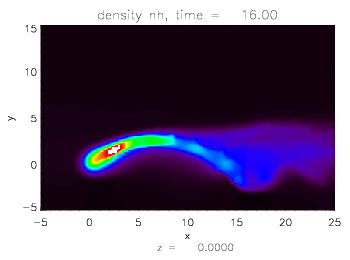
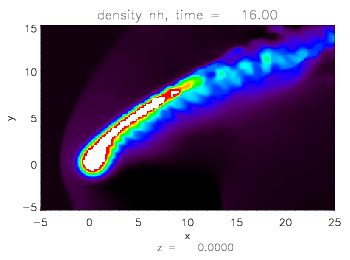
Panel 1: Contour plots of cometary ion density for different values
of mass loading rate
and cometary ion mass number (left: A=2, right: A=10). The magnetic field is
pointing upwards, while the solar wind is incident from the left at twice the
Alfven velocity. As mass loading increases, clump-like instabilities arise in
the comet's tail.
(Click on images to download the respective MPEG movies.)
|
|
|
|
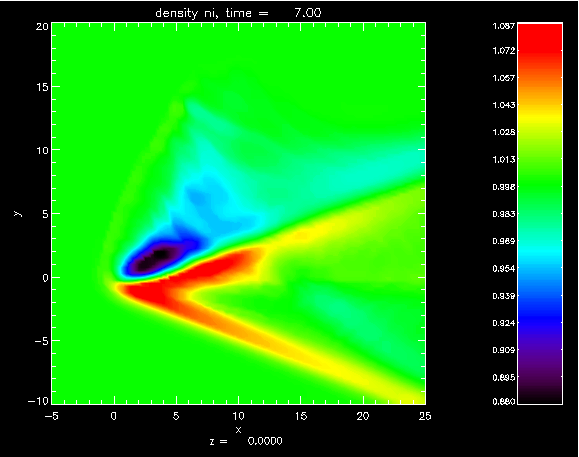
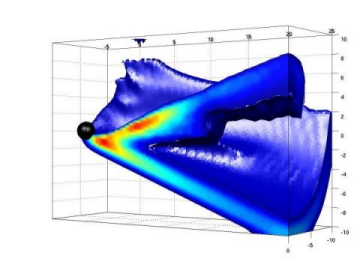
Panel 2: The left figure
shows a density contour plot in the plane of incoming flow (from the left) and
the magnetic field (initially oriented vertically, not shown here).
Asymmetric, cone-like
structures emanate from the obstacle, whose shape departs markedly from the
cylindrically-symmetric Mach cones known from HD or single-fluid MHD
simulations. Using a 3D grid for the simulation, the cone structure can
easily be visualized generating rotational iso-surfaces, as shown in the
figure to the right.
(Click on the left image for a larger view, or the right image for
an MPEG movie featuring a full 360° rotation of this configuration.)
|
*** Please note that this page and all its media files (movies and imagery)
are provided subject to this disclaimer.
***
Back to main page.