


Heliophysics
The heliosphere is a giant circumsolar plasma cocoon with a diameter of the order of several hundred astronomical units. It shields the planets from a direct contact with the interstellar medium by deflecting the interstellar plasma flow, by efficiently ionizing neutral gas components and by reducing the flux of cosmic rays. The structure of the heliosphere is changing in time due to solar activity and to a changing interstellar environment.
Contemporary research considers the Sun and the heliosphere as an integrated system, whose parts should be considered separately but are tightly interconnected by, for example, the solar/heliospheric magnetic field.
An understanding of the heliosphere is not only desirable in view of its role as a shield protecting life on Earth but also as natural plasmaphysical laboratory in which many fundamental plasma physical process, like turbulent diffusion, stochastic acceleration or nonthermal heating by plasma waves, can be studied. Narrowing the focus from the global to the inner heliosphere leads directly to the field of Space Weather, i.e. the influence of the Sun on the interplanetary medium, in general, and the terrestrial magnetosphere and atmosphere, in particular.
Widening the focus enables one to consider the heliosphere as an example for astrospheres around other stars and brings one to consider the nature of the interstellar medium including the transport of cosmic rays within.
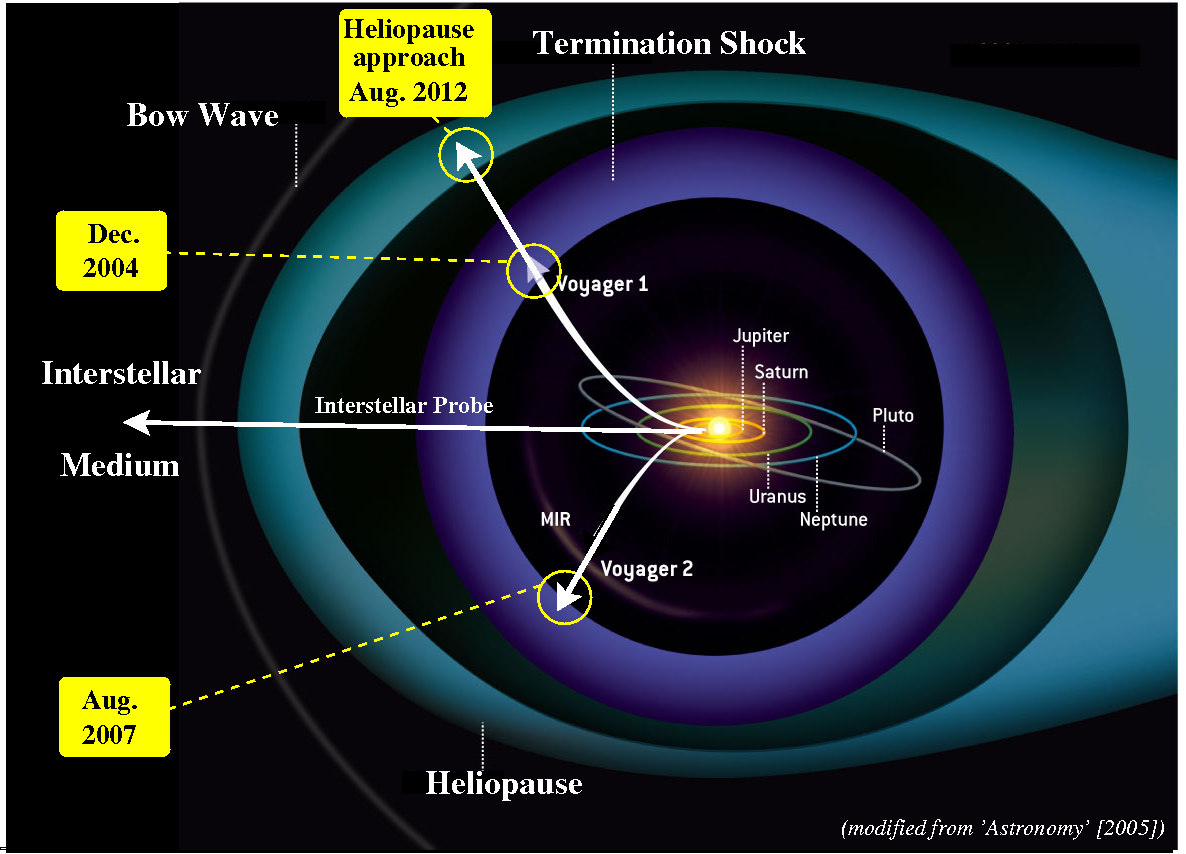
Sketch of the heliosphere and its constituents
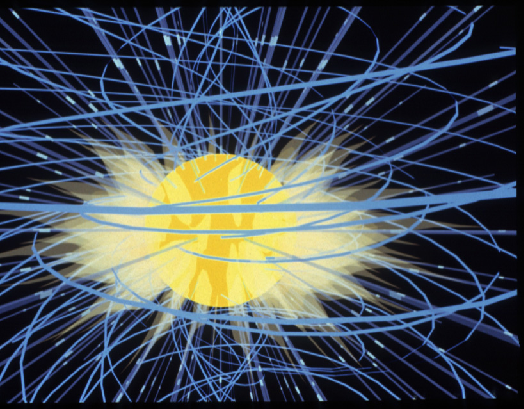
Artist’s conception of the solar magnetic field, with field lines shown as blue ribbons.
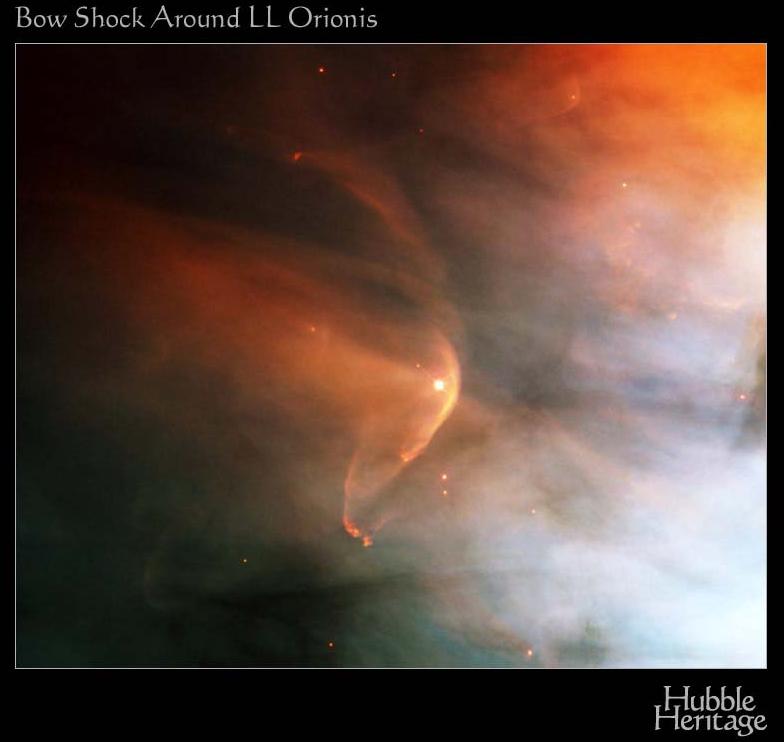
Hubble telescope image showing an illuminated bow shock at another star. Credits: NASA, ESA, and The Hubble Heritage Team (STScI/AURA).
Group seminar
Mon 15-17, NB 7/67
| Day | Lecturer | Title |
|---|---|---|
| 12.10.2026 | Jacob Heerikhuisen | Simulations of the Heliosphere |
| 19.10.2026 | ||
| 26.10.2026 | ||
| 02.11.2026 | ||
| 09.11.2026 | Jens Kleimann | The Solar Cosmic-Ray Shadow |
| 16.11.2026 | --- | (SFB-GA / UKL-Sitzung) |
| 23.11.2026 | Linus Glanemann | Simulations of Galactic Winds |
| 30.11.2026 | Dustin Schröder | Disputation Rehearsal (?) |
| 07.12.2026 | --- | Visit to Tiflis |
| 14.12.2026 | --- | (UKL-Sitzung) |
| 21.12.2026 | ||
| 11.01.2027 | Lukas Westrich | Transient Quasi-Discontinuous Solar-Wind Structures |
| 18.01.2027 | Alexander Vinogradov | Impact of Suprathermal Electrons on the Solar-Wind Expansion |
| 25.01.2027 | --- | (UKL-Sitzung) |
| 01.02.2027 | ||
Lecture notes
PD Dr. H. Fichtner
PD Dr. H. Fichtner & Dr. U. Arendt